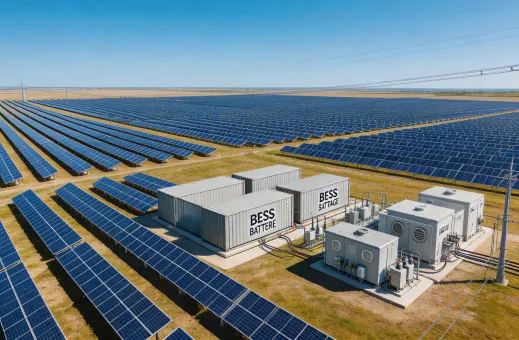
Utility solar and storage
Large sites need containerized storage, transformer coordination, inverter stations and protective devices that can be documented for interconnect review.

Eaton serves industries where renewable energy systems must coordinate generation, storage, protection and consumption under real operating pressure.
Large sites need containerized storage, transformer coordination, inverter stations and protective devices that can be documented for interconnect review.
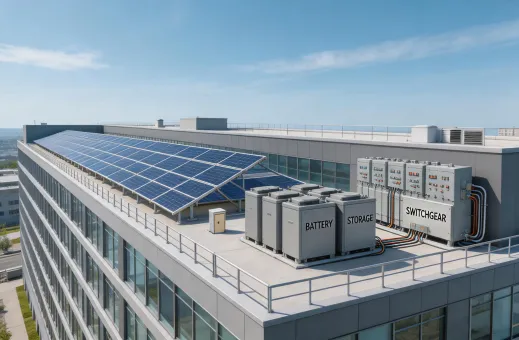
Facilities use Eaton guidance to connect backup, peak shaving, solar generation and transfer behavior without losing sight of service access.
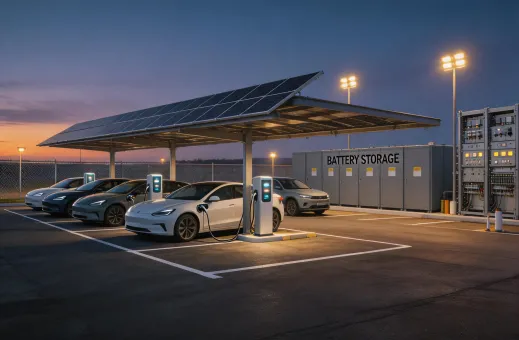
Charging loads are planned against service capacity, storage dispatch and future expansion rather than treated as isolated pedestals.
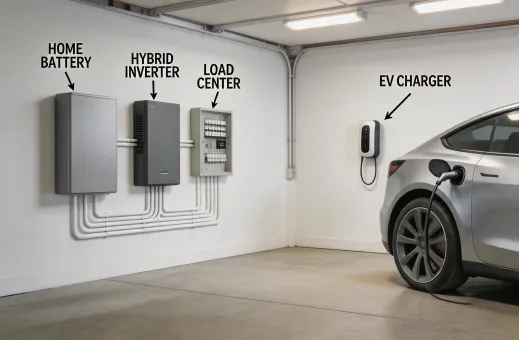
Home battery, surge protection and inverter decisions are arranged around safety, autonomy and maintainable electrical layout.
A project team had separate procurement lists for combiner boxes, disconnects, surge protection and transformer interface equipment. Eaton helped organize the scope around voltage class, environment, service access and submittal evidence. The result was a clearer review package and fewer unresolved notes before release.
A facility adding battery storage and EV chargers needed to protect production uptime while controlling demand. Eaton framed the review around load hierarchy, backup duration, transfer behavior and monitoring points, allowing the team to compare equipment options using operating evidence instead of assumptions.
A depot operator needed a first phase that would not block later charger additions. Eaton guided the discussion toward switchgear capacity, protection coordination, battery augmentation and data visibility so the installation could evolve without rebuilding the electrical backbone.
Across industries, the recurring need is the same: renewable energy equipment must be selected in context. Battery storage has to match the duty cycle and safety envelope. Inverters need compatible protection and grid settings. EV charging loads can change the service profile of an entire facility. BOS components look small on a bill of materials but become critical during installation, emergency shutdown or maintenance. Eaton's approach makes those relationships explicit so owners, EPCs, engineers and procurement teams can work from the same technical picture.
Battery chemistry is the most consequential decision in any energy storage project. We do not recommend a single answer for every customer; the choice depends on safety priorities, available footprint, and total cost over the system life. Both options are presented here so procurement and engineering teams can decide on common evidence.
Thermal runaway onset above 270 C, cycle life typically rated 6,000+ cycles at 90% DoD per IEC 62619 testing, and lower LCOS over a 15-year window. Now the dominant chemistry in residential and utility BESS, with UL 9540A test reports widely available.
Energy density roughly 30-40% higher than LFP, smaller cabinet footprint per kWh, and proven track record in EV applications. Better suited to space-constrained commercial rooftops and projects where weight or volume is the binding constraint.
Eaton can share UL 9540A test summaries, IEC 62619 reports, and round-trip efficiency data on request so the trade-off is decided on numbers, not marketing.
Send site type, voltage class, load profile and project phase for an engineering-first discussion.
Start Application Review